3D Printing a Brain
Reading Time: 2 minutesTags: 3d-printing casting
This was a fun project I did back in 2021. It's funny the first artificial brain I made was 3D printed rather than anything to do with my AI work.
A friend was finishing their PhD in neuroscience and their partner wanted to commemorate the achievement. Doing a neuroscience PhD, my friend had MRI scanned a lot of brains (as you do), including their own.
Her partner and I got a hold of that scan and decided to make a little trophy.
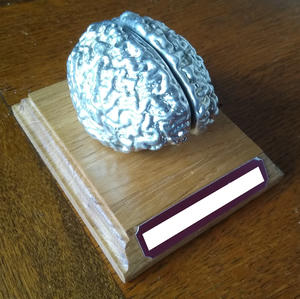
The process was this:
- Convert the DICOM file to a mesh.
- Clean the mesh manually in Blender to make it watertight and printable in two halves. Handily, brains come ready split into two hemispheres with a flat-ish plane dividing them.
- Print the halves on a SLA printer. SLA was a good choice as it gives a nice smooth finish. No layer lines. No loosing the will to live sanding a surface covered in folds.
- Create a negative mold for each half by casting around it with high-temperature silicone (Smooth-On)
- Melt some pewter, pour it into the silicone molds, leave to cool.
- Extract the halves, the silicone is flexible enough to allow this even though the brains folds locked into it.
- Glue the halves together with epoxy.
For the base I started with a piece of stock about the right size and used a profiled router bit on the sides and back edge. I swapped to chamfer bit to do the front. The brain rests on a little 3D printed I just plaque online.
All in all I learned about medical file types, tried several new manufacturing processes, and was pleasantly surprised how polished I got the final result.